
£120.00
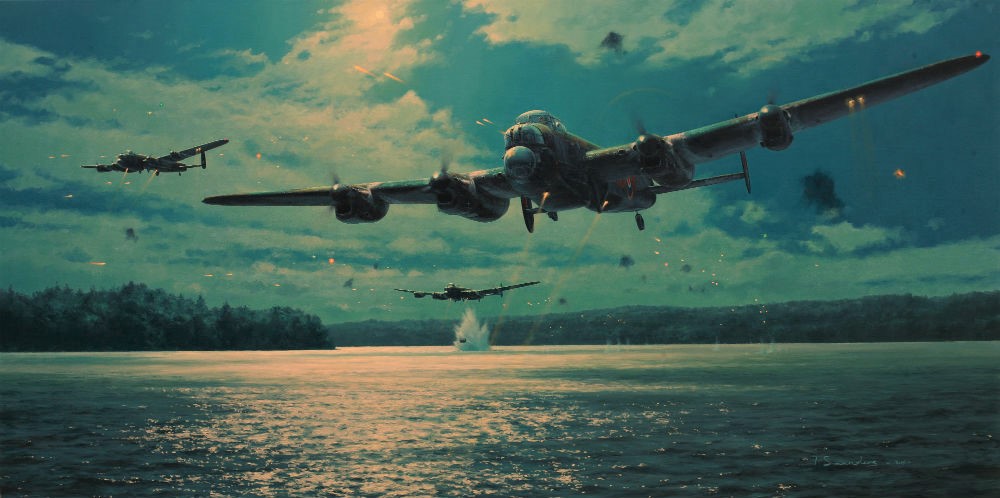
Anthony Saunders’ painting, Approach to the Möhne, is already hailed as a masterpiece of aviation art and one of the most authentic interpretations of events yet created, captures the moment when the fate of the Mohne dam was sealed.
To commemorate the Anniversary of Operation Chastise, one of the most audacious air raids of WWII each print is personally signed by a veterans who was directly involved in the raid and the Daughter of the Bouncing Bomb designer Barnes Wallis:
Britain found herself at war with Germany once again in September 1939. Immediately, military leaders looked for ways to weaken the German industrial machine. Specifically, they focused their attention on the massive dams in the Ruhr Valley. These structures were vital because they controlled water for steel production and electricity. As a result, destroying them would strike a devastating blow to German manufacturing. For collectors of military history, this dramatic moment is beautifully captured in our Dambusters limited edition print.
Attacking these targets presented massive tactical problems. Existing aircraft struggled to survive heavy dam defenses at low levels, and commanders believed commando raids would be suicidal. However, engineer Barnes Wallis conceived a brilliant solution: the “bouncing bomb,” codenamed Upkeep. This Limited Edition Print celebrates the genius behind this mine, which was designed to skip over torpedo nets and explode directly against the dam wall for maximum impact.
Success required pilots with extraordinary skills and a large, powerful aircraft. By March 1943, the RAF met all the criteria, forming 617 Squadron under Wing Commander Guy Gibson. Additionally, they chose the mighty Avro Lancaster for the task. If you are a collector of history’s most famous bombers, you can find more artwork in our Avro Lancaster Heritage Collection. On 16 May 1943, Gibson led the first wave of bombers from RAF Scampton, and the legendary Dambuster raid began.
The dam still held firm after three dangerous attempts. At this critical point, Flight Lieutenant David Maltby took his turn in Lancaster AJ-J. This Limited Edition Print captures the incredible tension of that moment. Mick Martin and Guy Gibson flew on his flanks to draw intense enemy fire. Meanwhile, Maltby held his aircraft steady while bomb aimer John Fort released their Upkeep mine. To view the technical history of the aircraft used in this raid, visit the Official RAF Museum website.
The mine bounced perfectly and hit the target at 00.49 hrs on 17 May 1943. Soon after, it sank and detonated against the stone wall. The immense water pressure finally forced the granite blocks to crack; suddenly, the wall shuddered and collapsed. Gibson later described a breach 100 yards wide with water gushing into the Ruhr valley. This Limited Edition Print honors the bravery of the crews and a mission many thought was impossible.
| Dimensions | 67.31 × 50.16 cm |
|---|---|
| Print Type | Signed and Numbered, Artists Proof |
Reviews
There are no reviews yet.