
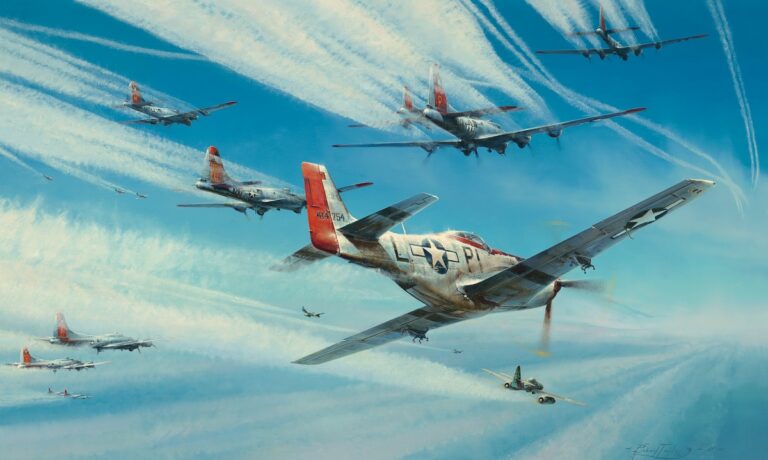
By the final months of the Second World War, the Messerschmitt Me 262 had introduced Allied aircrews to the speed and threat of an operational jet fighter.
On 10 April 1945, a huge force of Eighth Air Force bombers and escorts struck targets in Germany. The scene depicted here shows B-17s of the First Air Division turning for home as Me 262s attack the formation, while P-51 pilot Wayne Gatlin of the 356th Fighter Group closes on one of the jets.
The encounter captures a pivotal moment: piston-engined fighters confronting a technology that pointed towards the future of air combat.
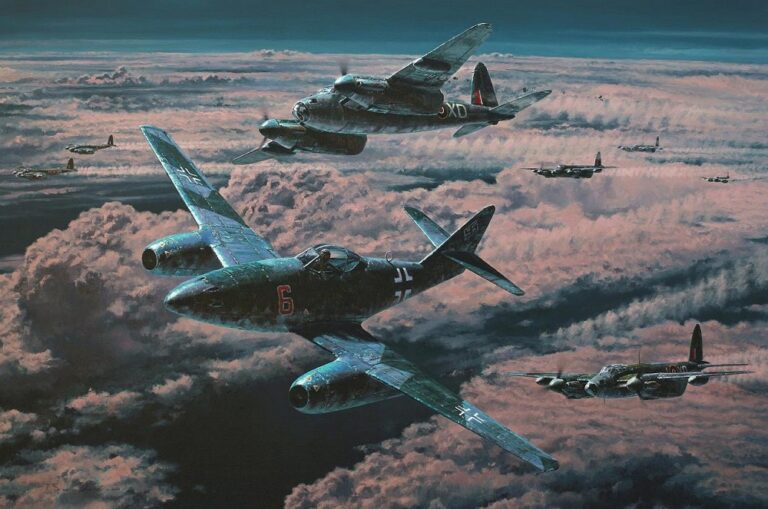
The arrival of jet aircraft also began to change night fighting. Greater speed, combined with developing airborne radar and interception techniques, pointed towards a future in which night combat would depend increasingly on technology rather than eyesight alone.
This scene depicts an Me 262A of NJG 11 defending Berlin during the closing stages of the Second World War. Leutnant Jörg Cypionka engages RAF Mosquitos of 139 (Jamaica) Squadron, part of the Pathfinder Force.
It illustrates the extraordinary pace of wartime aviation development and the beginnings of the jet-powered night-fighter era.
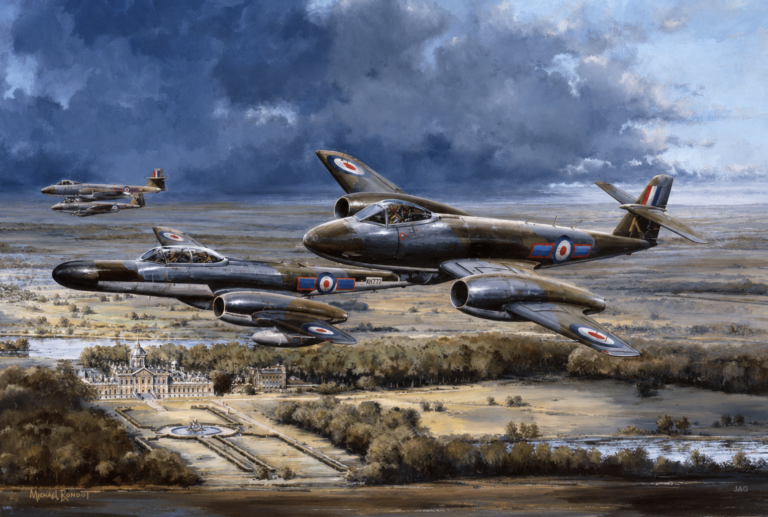
The Gloster Meteor was Britain’s first operational jet fighter and the only Allied jet aircraft to see operational service during the Second World War. Entering RAF service in 1944, it represented a major step from piston-powered fighters towards the emerging jet age.
Early Meteors were initially used against V-1 flying bombs before later operations over continental Europe. Although they did not meet the Me 262 in air-to-air combat, the Meteor demonstrated the potential of jet propulsion in frontline service.
Its development helped establish the experience and technology that would shape Britain’s post-war generation of military jet aircraft.

The English Electric Canberra entered RAF service in the early 1950s and became one of Britain’s most successful early jet aircraft. Designed as a high-performance light bomber, its speed, altitude capability and adaptability gave it a remarkably long service life.
The Canberra served in bombing, reconnaissance and specialist roles, while its design was adopted internationally and produced in the United States as the Martin B-57.
For the RAF, it represented an important step in the development of post-war jet operations, combining performance with versatility and demonstrating how rapidly military aviation had progressed since the first wartime jets.
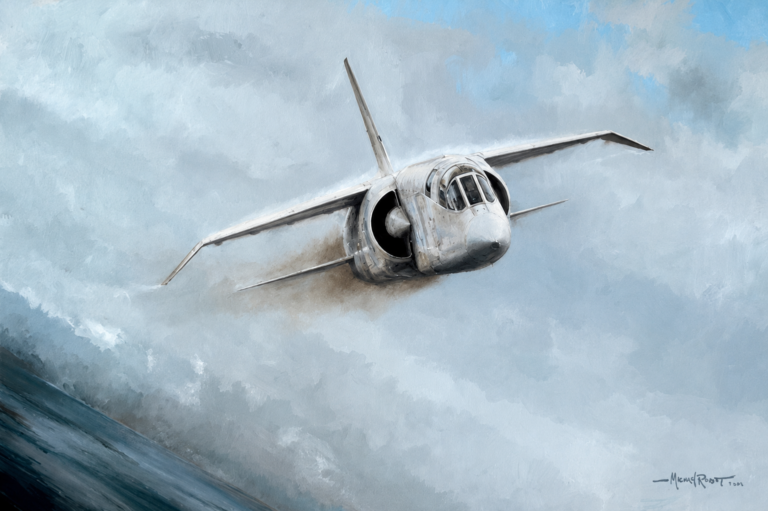
The BAC TSR2 was conceived as an advanced RAF tactical strike and reconnaissance aircraft capable of high-speed, low-level penetration in demanding conditions. Its sophisticated avionics, powerful Olympus engines and ambitious performance requirements made it one of Britain’s most advanced aircraft projects of the 1960s.
Only one aircraft flew before the programme was cancelled in 1965, making TSR2 one of the great “what if?” stories of British military aviation.
Although it never entered service, the aircraft remains a powerful symbol of British aerospace ambition and of a period when rapidly changing technology, strategy and defence policy were reshaping the future of military aviation.