
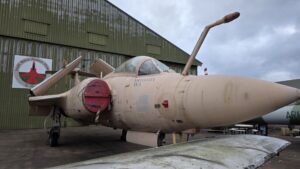
Welcome to the first of our Museum Diaries, where we visit museums and preservation groups around the UK that are keeping our Jet Age heritage alive. We start with our local museum, the South Wales Aviation Museum (SWAM) at St Athan.
Located at St Athan, this is a must-visit destination for aviation enthusiasts, historians, and families looking for an up-close look at the UK’s rich aerospace heritage. Situated near the former RAF St Athan, a site with deep roots in military maintenance and training, SWAM is a vibrant, hands-on museum dedicated to preserving, restoring, and displaying significant aircraft and artifacts. Unlike traditional museums, SWAM offers a unique, informal setting where visitors can get exceptionally close to Cold War legends and iconic jets, providing fantastic photo opportunities and educational experiences about the engineering and operational history of these magnificent machines. On some visits you can get into the cockpits and experience a pilot’s-eye view.
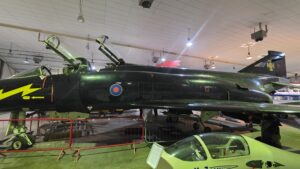
SWAM features the mighty McDonnell Douglas F-4 Phantom II, a supersonic icon that served as the backbone of the RAF’s air defence from the late 1960s. The British Phantoms were unique, fitted with powerful Rolls-Royce Spey engines that necessitated significant airframe modifications. You can explore more RAF Phantom history through our Phantom Boys first-hand accounts and Phantom Patrol aviation art and our collection of RAF F-4 Phantom II prints. Adapted for the RAF to perform crucial Quick Reaction Alert (QRA) duties, the Phantom secured UK airspace throughout the Cold War.
Featured Aircraft: XV582. This particular Phantom FGR.2 aircraft is known for its long service with the RAF, specifically operating with 228 Operational Conversion Unit (OCU) and later with 111 Squadron (The Black Knights). It spent its final operational years performing crucial air defense tasks and training the next generation of Phantom pilots and navigators.
XV582 holds a unique record. It was realized that no official air speed record existed between the two furthest points in the mainland United Kingdom: John O’ Groats in Scotland and Land’s End in Cornwall. On 24th February 1988, with Wing Commander John Brady piloting and Flight Lieutenant Michael Pugh navigating, the Phantom completed the course in a record time of 46 minutes and 44 seconds, achieving an average speed of over 772 mph. This incredible speed included short supersonic legs over water, as UK airspace regulations prohibited supersonic speeds over land, establishing a record that was ratified by the Fédération Aéronautique Internationale and remains unbroken today.
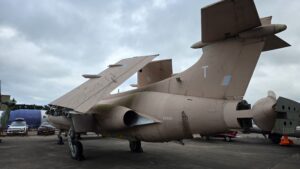
Outside you will find the Blackburn Buccaneer, a robust and rugged low-level strike aircraft originally designed for the Royal Navy to conduct high-speed maritime attack. Adopted by the RAF, the Buccaneer’s career highlight was its service during the Gulf War, where its laser designation capabilities proved invaluable for guiding precision munitions. Our Buccaneer Boys book and Blackburn Buccaneer: Blue Fire continue that story through first-hand accounts and aviation art.
Featured Aircraft: XX889. This particular Buccaneer S.2B has a distinguished combat pedigree. It served with 12 Squadron and 208 Squadron and was one of the aircraft deployed to the Middle East for the First Gulf War (Operation Granby) in 1991. It participated in the crucial high-speed, low-level strike missions that neutralized Iraqi targets, cementing its status as a proven combat veteran.

The museum proudly displays a Harrier, representing one of Britain’s greatest aviation innovations. The Sea Harrier pioneered true Vertical/Short Take-Off and Landing (V/STOL) capabilities and achieved legendary status in the 1982 Falklands War for its air combat successes. This jump jet provided vital air cover for the Royal Navy Task Force. For more on the aircraft, see our Sea Harriers limited edition print and Harrier Boys: Volume One.
Featured Aircraft: ZD433. This aircraft is a Sea Harrier F/A.2 (the upgraded version), which first flew in 1982. It saw service with 801 Naval Air Squadron (NAS) and notably took part in operations over the Balkans (Kosovo and Bosnia) in the late 1990s, flying combat missions from the decks of Royal Navy aircraft carriers, demonstrating the extended multi-role capability of the Harrier family.
There are other aircraft outside and some interesting exhibits in the various rooms off the main hangar. As our local museum we visit regularly and love watching the children getting up close and personal with these iconic aircraft.
South Wales Aviation Museum is open on Saturdays and Sundays from 10am to 4pm. It has a great café, so you can start or end your tour with a light bite.
For more information visit: https://www.southwalesaviationmuseum.com/
