


The de Havilland Comet first flew in 1949 and entered BOAC service on 2 May 1952. It was the world’s first commercial jet airliner, offering faster journeys and a quieter cabin than piston-engined aircraft. Its early London-to-Johannesburg service still required several stops. Following several fatal accidents, investigations revealed metal-fatigue problems linked to repeated cabin pressurisation. The early Comets were grounded, and the lessons learned changed airliner design and testing. A redesigned Comet 4 returned to service in 1958.
The original Comet was a bold British engineering achievement, with four engines integrated into the wing roots and a pressurised cabin designed for high-altitude cruising. Its early routes were operated by BOAC and demonstrated the appeal of jet travel to passengers who had previously spent far longer in piston-powered airliners.
The lessons of the Comet programme extended well beyond Britain. Engineers learned how repeated cabin pressurisation could expose weaknesses that were not obvious in conventional ground testing. Improved structural design, more rigorous fatigue testing and new maintenance practices influenced later generations of passenger aircraft.

BOAC began scheduled transatlantic Comet 4 services in October 1958. Pan American followed with Boeing 707 transatlantic jet services later that month. The 707 carried more passengers and helped establish the long-range jet airliner as the new standard for international travel. Its swept wings, four pod-mounted engines and greater capacity made it a familiar sight at major airports. Airlines could offer faster schedules and carry more passengers on long-distance routes.
The 707 first flew in December 1957 and entered airline service with Pan American in October 1958. Its four jet engines and pressurised cabin enabled high-altitude cruising at speeds that made ocean crossings much more convenient. Boeing developed several versions of the aircraft, adapting it to different airline requirements and route lengths. The 707 also helped establish the familiar appearance of the modern jet airliner, with swept wings and engines suspended beneath them.
For BOAC, the type became an important part of the long-haul fleet during the 1960s, linking Britain with destinations around the world.

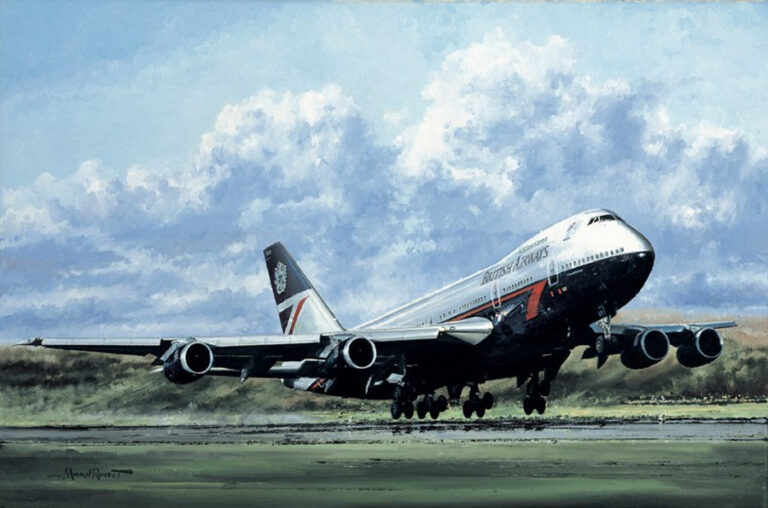
The Boeing 747 entered commercial service in 1970, transforming long-haul travel with its wide-body cabin and unprecedented passenger capacity. Its distinctive upper-deck hump became an instantly recognisable symbol of international air travel.
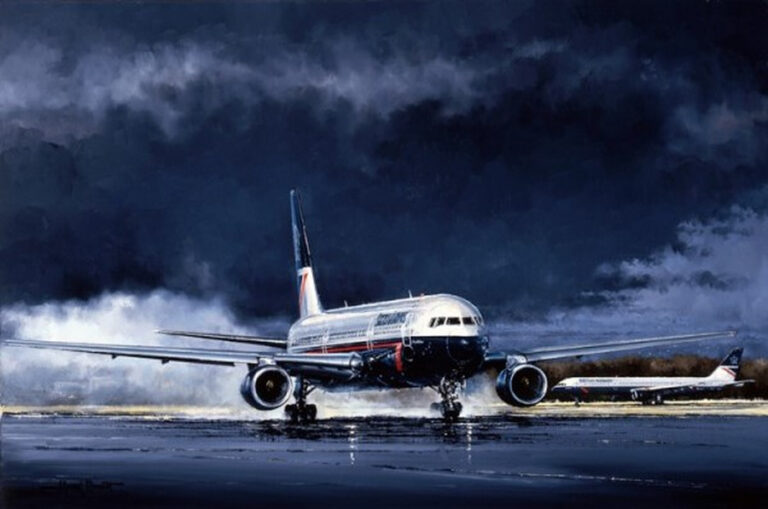
The later Boeing 767 entered airline service in 1982, bringing twin-engined efficiency to medium- and long-haul routes. British Airways operated the 747 from 1971 until 2020, while its Boeing 767 fleet served from 1990 to 2018.
These aircraft represented different generations of commercial aviation, balancing capacity, operating costs and route flexibility. The 747 made wide-body travel a defining feature of the 1970s, while the twin-engined 767 reflected a growing emphasis on fuel efficiency and flexible route planning.

Concorde represented a very different ambition: not to carry ever more passengers, but to make the world dramatically smaller through speed. Developed jointly by Britain and France, the slender delta-wing airliner first flew in 1969 and entered scheduled passenger service with British Airways and Air France in January 1976. Cruising at around Mach 2, at altitudes of approximately 60,000 feet, Concorde could cross the Atlantic between London and New York in roughly three and a half hours—less than half the journey time of conventional subsonic airliners.
Its distinctive drooping nose, powerful Olympus engines and elegant silhouette made it one of the most recognisable aircraft ever built. Yet Concorde was also an extraordinary technical undertaking, demanding specialist maintenance, highly trained crews and operating procedures unlike those of other passenger jets. High operating costs, restrictions on supersonic flight over land and changing commercial conditions limited its wider adoption.
British Airways retired Concorde from passenger service in October 2003, bringing an extraordinary chapter of commercial aviation to a close. From the pioneering Comet through the 707 and 747 to Concorde, these aircraft reflect contrasting ambitions—speed, capacity, range and efficiency.